THE LITTLE BIT OF MADNESS
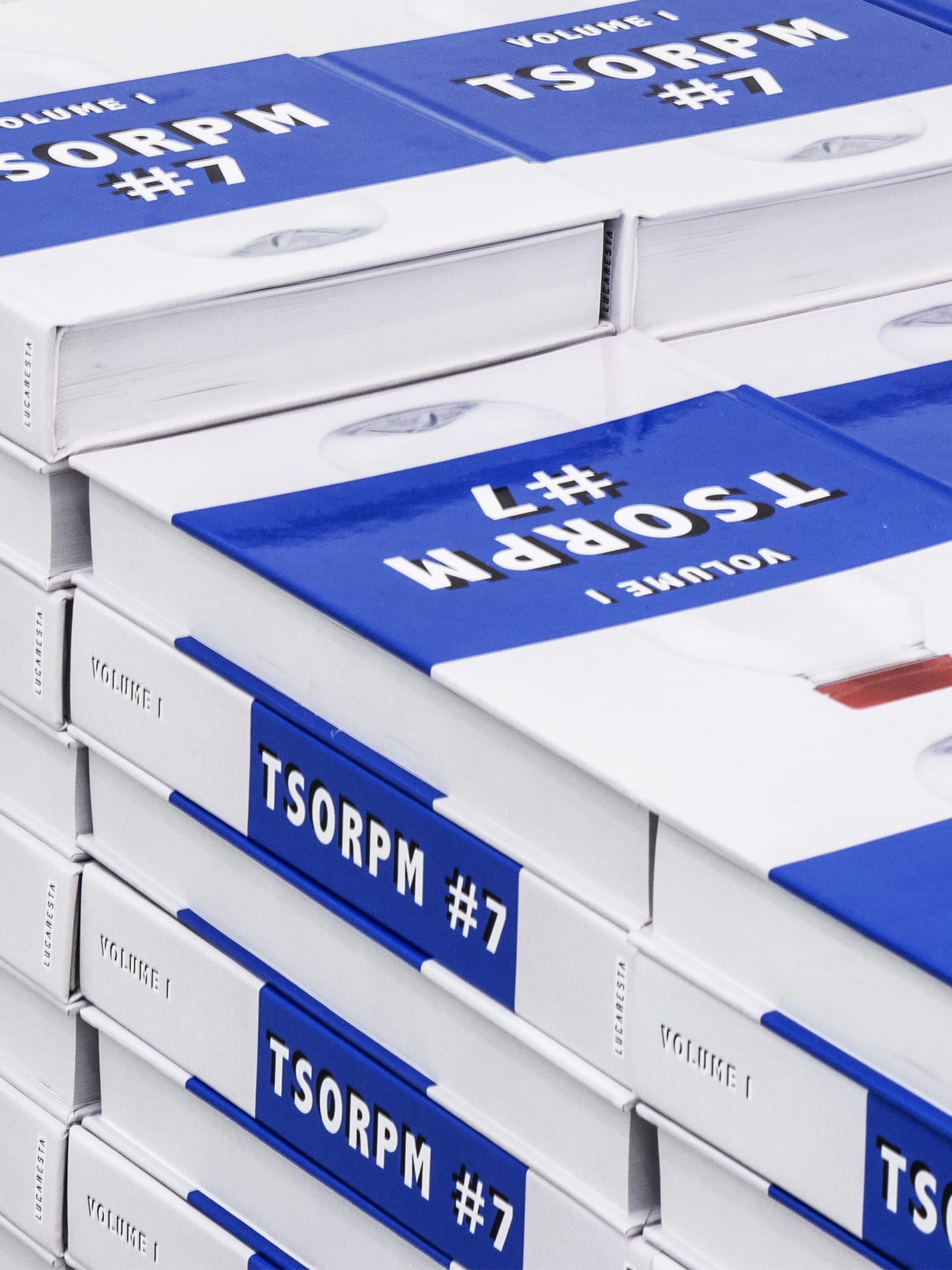
by Elio Grazioli, in TSORPM #7, Paris, 2022, pp. 15-18
There’s more than one way to gather, accumulate, archive, collect. It can be a real mania, under the weight of which some have literally collapsed, a passion or a cure, a detour or a necessity. Clearly, today it has returned to the agenda in many ways, naturally because its characters have changed with the advent of digitization and because finding a new order to the quantity of “data” and the keys to “navigate” their ocean is one of the most urgent issues of this post-world.
Of course, putting it under the banner of monsters generated by the Sleep of Reason as Luca Resta does, makes it take on a definitely critical meaning. Everyone remembers Goya’s engraving from which the title of Luca’s series (TSORPM) originates: all-around a sleeping man lying on a work table a multitude of nocturnal birds descend, owls and bats, mocking and threatening him. Is the mass-disorder of the birds-monsters the collection? Only when reason-order fails? As is well known, there is a cat at the feet of a man, who has his eyes wide open: is it part of the nightmare, or does he see it too, even though he is not dreaming? Is the Sleep of Reason his awakening? One of the birds seems to be turning to him, but the cat has other weapons to cope. For Yves Bonnefoy, his eyes refer to madman's wide eyes but also to the “fidelity to seeing” of the artist who saw these eyes without batting an eyelid.
Perhaps the role of the collection that Resta offers us is due to this: it is within madness that its antidote must be sought, at least a little is needed. Let reason sleep on, art will bring out its monsters and do something else and seek another order for them. By this, I mean that, however, the question took a different turn from when artists exhibited sets and collections. Museums, archives, and collections have their history, but at a certain point, something took place, in conjunction with substantial changes, which broke down the boundaries of categories and areas and put everything back into play.
Practices and theories have multiplied, new methodologies, new disciplines, new museums, new archives, new ways of collecting. Ready-made, pastiche, assemblage, bricolage, assembly, obsolescence, the theories have multiplied. Collectors began to claim an artistic character even to their “work” made up of the works of others until the artists themselves exhibited their accumulations or collections as their own “work”.
The quotation marks are essential because, here too, they mark the change in the conception of the work itself and in the categories that define it: no more preparatory material, no more ideation, documentation, combination or accompanying material, no more collections of artists of inspiration or affinity, but also collections until then just considered as private curiosities, clippings, postcards, photos found, gadgets, shamrocks, objects of all kinds, selected by topics, genre, combination, path—like an exhibition, it will be noted, and hence exhibition of the exhibition, artist-curator and so on.
To put it differently: the collection, the archive, the set, the museum itself have become “forms”. And so their devices: the frame, the pedestal, the showcase, the caption, the display methods. Or, have become “medium”, as it is also used to say, i.e. a set of rules adopted to make them mean. The question is not evident, because just as the collection is a whole, so is a form or a medium, therefore, we can see the collection pieces as rules: here are Goya’s birds that begin to take on another meaning, their other sense. Which? For example, that of Karsten Bott for whom uniqueness is not a question of quantity, of Madelon Vriesendorp for whom even that of gadgets is a world, of Stefano Arienti for whom images have an emotional value, of Georges Adéagbo for whom the collection is a resurrection, of Tacita Dean for whom it is a perfect interweaving of causality and concentration, of Luca Pancrazzi for whom it is the asymmetry of opposites.
Luca Resta has collected and gathered objects of different types but all of everyday use, packaging boxes, plastic cutlery, frames, bottles, as well as images and words. Of course, every kind of object has symbolic values and historical references. It is clear that the boxes refer to Andy Warhol’s Boxes, words to conceptual art, frames to painting, cutlery to design as well as bottles, and perhaps to minimalism for the minimal variation of shapes. Cutlery and bottles also have in common that they are objects linked to food consumption, one solid and the other liquid. Some boxes are too, for example, kebab boxes. Boxes and frames, in turn, have in common that they are containers, just like bottles.
In short, objects build sets, intertwining, juxtapositions, so that even words and images end up being interpretable according to reflections of these consonances and differences. On the other hand, the objects of these series also come into play in various modes in other series, multiplying the references from one to the other: for example, some boxes, as well as some cutlery, were made by the artist in marble, or some bottles have been covered with scotch tape—material change, appearance change, simulation and counter-simulation.
But two other characteristics mark the series of collections originally. The first is that every time there is something strange that manifests itself through different clues. Unlike those of Warhol, Resta’s boxes are visibly worn out; frames contain monochrome surfaces that are always the same but turn out to be made with gunpowder; the work carried out on the words is a tidying up that cancels their original meaning; the images are projected at a speed that makes them almost hypnotic; the emphasis on the shapes of the cutlery and bottles contradicts their banality.
The second feature is the display mode, which perhaps respects at the same time, again, their usual way but with a different character: so the boxes are stacked along the walls as is done in a warehouse, but until they were completely covered, occluding space and vision1; the plastic cutlery, likeable put away in their cases or drawers, but at the same time displayed as sculptures on a pedestal2; images received by email remain transmitted on a monitor, but without any more information3; words are displayed in the vaults of a library, but unlike any book contained therein4; frames are displayed on the ground as if waiting to be set up5; finally, the bottles, here they are “exhibited” in a book…
All this, therefore, to say something simple but, I believe, decisive, i.e. the book you have in your hands is, in turn, a collection, not only because it refers to a collection, but also, in the sense of the collection form, because it is a collection of images and words, collection of collection. This is what makes up a collection, in the double sense of the expression, which constitutes it and is constituted by it. Hundreds of bottles photographed very simply in the centre and on a neutral background are here only apparently to be themselves, to present themselves, almost obtusely, as if to remove themselves from any meaning, zero degrees. In reality, they are explosive, another gunpowder breeding, so as the photograph is another image that deceives about its coincidence with the word, just as the book is another container that does not enclose perfectly.
It seems a calm, neutral and harmless operation, but everything explodes in all directions.
Finally, let us go back to the Goya-like title to make a final observation: as in the case of Goya, there is also a denunciation aspect in that of Resta. It is clear that the collection also has an allegorical meaning of the times, of the culture, of the society it represents, that is, that it always emerges, beyond the explosions, from the collected objects, intimately and inevitably linked to their material and cultural contexts, as well as to our, present, current times. Left to act on its own, this allegorical charge is neither emphasized nor thematized so that it does not end in its aspect of denunciation but instead invites us to look at it, and to look, differently, with cat’s eyes. Only in this way the mania, the compulsion, the obsessive repetition, the claustrophobic character of the accumulation of our society can take on another meaning and show us other directions to take.
E. Grazioli, “The little bit of madness”, in TSORPM #7, Paris, 2022
There’s more than one way to gather, accumulate, archive, collect. It can be a real mania, under the weight of which some have literally collapsed, a passion or a cure, a detour or a necessity. Clearly, today it has returned to the agenda in many ways, naturally because its characters have changed with the advent of digitization and because finding a new order to the quantity of “data” and the keys to “navigate” their ocean is one of the most urgent issues of this post-world.
Of course, putting it under the banner of monsters generated by the Sleep of Reason as Luca Resta does, makes it take on a definitely critical meaning. Everyone remembers Goya’s engraving from which the title of Luca’s series (TSORPM) originates: all-around a sleeping man lying on a work table a multitude of nocturnal birds descend, owls and bats, mocking and threatening him. Is the mass-disorder of the birds-monsters the collection? Only when reason-order fails? As is well known, there is a cat at the feet of a man, who has his eyes wide open: is it part of the nightmare, or does he see it too, even though he is not dreaming? Is the Sleep of Reason his awakening? One of the birds seems to be turning to him, but the cat has other weapons to cope. For Yves Bonnefoy, his eyes refer to madman's wide eyes but also to the “fidelity to seeing” of the artist who saw these eyes without batting an eyelid.
Perhaps the role of the collection that Resta offers us is due to this: it is within madness that its antidote must be sought, at least a little is needed. Let reason sleep on, art will bring out its monsters and do something else and seek another order for them. By this, I mean that, however, the question took a different turn from when artists exhibited sets and collections. Museums, archives, and collections have their history, but at a certain point, something took place, in conjunction with substantial changes, which broke down the boundaries of categories and areas and put everything back into play.
Practices and theories have multiplied, new methodologies, new disciplines, new museums, new archives, new ways of collecting. Ready-made, pastiche, assemblage, bricolage, assembly, obsolescence, the theories have multiplied. Collectors began to claim an artistic character even to their “work” made up of the works of others until the artists themselves exhibited their accumulations or collections as their own “work”.
The quotation marks are essential because, here too, they mark the change in the conception of the work itself and in the categories that define it: no more preparatory material, no more ideation, documentation, combination or accompanying material, no more collections of artists of inspiration or affinity, but also collections until then just considered as private curiosities, clippings, postcards, photos found, gadgets, shamrocks, objects of all kinds, selected by topics, genre, combination, path—like an exhibition, it will be noted, and hence exhibition of the exhibition, artist-curator and so on.
To put it differently: the collection, the archive, the set, the museum itself have become “forms”. And so their devices: the frame, the pedestal, the showcase, the caption, the display methods. Or, have become “medium”, as it is also used to say, i.e. a set of rules adopted to make them mean. The question is not evident, because just as the collection is a whole, so is a form or a medium, therefore, we can see the collection pieces as rules: here are Goya’s birds that begin to take on another meaning, their other sense. Which? For example, that of Karsten Bott for whom uniqueness is not a question of quantity, of Madelon Vriesendorp for whom even that of gadgets is a world, of Stefano Arienti for whom images have an emotional value, of Georges Adéagbo for whom the collection is a resurrection, of Tacita Dean for whom it is a perfect interweaving of causality and concentration, of Luca Pancrazzi for whom it is the asymmetry of opposites.
Luca Resta has collected and gathered objects of different types but all of everyday use, packaging boxes, plastic cutlery, frames, bottles, as well as images and words. Of course, every kind of object has symbolic values and historical references. It is clear that the boxes refer to Andy Warhol’s Boxes, words to conceptual art, frames to painting, cutlery to design as well as bottles, and perhaps to minimalism for the minimal variation of shapes. Cutlery and bottles also have in common that they are objects linked to food consumption, one solid and the other liquid. Some boxes are too, for example, kebab boxes. Boxes and frames, in turn, have in common that they are containers, just like bottles.
In short, objects build sets, intertwining, juxtapositions, so that even words and images end up being interpretable according to reflections of these consonances and differences. On the other hand, the objects of these series also come into play in various modes in other series, multiplying the references from one to the other: for example, some boxes, as well as some cutlery, were made by the artist in marble, or some bottles have been covered with scotch tape—material change, appearance change, simulation and counter-simulation.
But two other characteristics mark the series of collections originally. The first is that every time there is something strange that manifests itself through different clues. Unlike those of Warhol, Resta’s boxes are visibly worn out; frames contain monochrome surfaces that are always the same but turn out to be made with gunpowder; the work carried out on the words is a tidying up that cancels their original meaning; the images are projected at a speed that makes them almost hypnotic; the emphasis on the shapes of the cutlery and bottles contradicts their banality.
The second feature is the display mode, which perhaps respects at the same time, again, their usual way but with a different character: so the boxes are stacked along the walls as is done in a warehouse, but until they were completely covered, occluding space and vision1; the plastic cutlery, likeable put away in their cases or drawers, but at the same time displayed as sculptures on a pedestal2; images received by email remain transmitted on a monitor, but without any more information3; words are displayed in the vaults of a library, but unlike any book contained therein4; frames are displayed on the ground as if waiting to be set up5; finally, the bottles, here they are “exhibited” in a book…
All this, therefore, to say something simple but, I believe, decisive, i.e. the book you have in your hands is, in turn, a collection, not only because it refers to a collection, but also, in the sense of the collection form, because it is a collection of images and words, collection of collection. This is what makes up a collection, in the double sense of the expression, which constitutes it and is constituted by it. Hundreds of bottles photographed very simply in the centre and on a neutral background are here only apparently to be themselves, to present themselves, almost obtusely, as if to remove themselves from any meaning, zero degrees. In reality, they are explosive, another gunpowder breeding, so as the photograph is another image that deceives about its coincidence with the word, just as the book is another container that does not enclose perfectly.
It seems a calm, neutral and harmless operation, but everything explodes in all directions.
Finally, let us go back to the Goya-like title to make a final observation: as in the case of Goya, there is also a denunciation aspect in that of Resta. It is clear that the collection also has an allegorical meaning of the times, of the culture, of the society it represents, that is, that it always emerges, beyond the explosions, from the collected objects, intimately and inevitably linked to their material and cultural contexts, as well as to our, present, current times. Left to act on its own, this allegorical charge is neither emphasized nor thematized so that it does not end in its aspect of denunciation but instead invites us to look at it, and to look, differently, with cat’s eyes. Only in this way the mania, the compulsion, the obsessive repetition, the claustrophobic character of the accumulation of our society can take on another meaning and show us other directions to take.
E. Grazioli, “The little bit of madness”, in TSORPM #7, Paris, 2022
PDF